
Electromagnetism
We apply our knowledge of physics to determine how the subsoil responds to an electromagnetic wave source. We send a signal into the subsoil, which interacts with the materials. This signal is then recorded and processed to interpret the conductivity in the targeted area. We have different types of devices depending on the project requirements and the type of data acquisition planned.
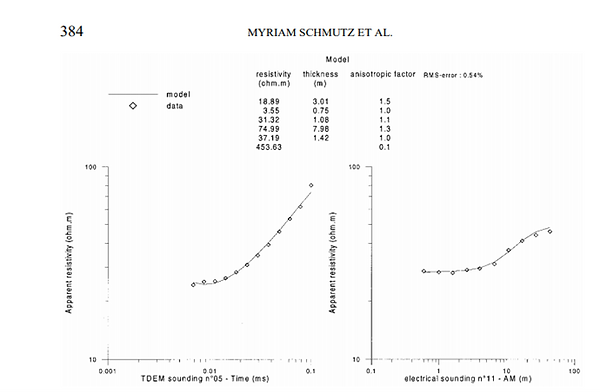
We can work in the time domain by measuring the decay time of the magnetic field intensity, or in the frequency domain for larger areas. We obtain profiles or maps of subsurface conductivity, similar to those obtained using the electrical method, but more sensitive to conductive materials such as metals.
TDEM
The devices used for electromagnetic acquisition are coils specifically designed to send signals underground and generate eddy currents. During the acquisition process, we install two coils, a transmitter and a receiver; these are the cable loops placed in the ground with a geometry that depends on the acquisition device defined for the mission.
Slingram (FDEM)
This method stems from the need for rapid data acquisition and precise sampling to understand the near subsurface. The Slingram method is based on the principle of electromagnetism mentioned earlier, which relies on the production of eddy currents that generate an electromagnetic field recorded by our instruments.
The Slingram is a device that can be easily carried and transported by a technician to acquire profile data. These devices have specific distances between the transmitting and receiving coils, allowing conductivity values to be recorded at precise depths in the near subsurface.
